dirt bike tire size guide
Dirt Bike Tire Size Guide: A Comprehensive Overview
Navigating the world of dirt bike tires involves understanding width, aspect ratios, and diameters, crucial for optimal performance and handling across varied terrains.
Understanding Dirt Bike Tire Sizes: The Basics
Dirt bike tire sizing can initially seem complex, but grasping the fundamentals unlocks informed choices for your riding experience. Sizes are typically represented by a series of numbers and letters – for example, 80/100-21. The first number, like ’80’, denotes the tire’s width in millimeters. Following this, the second number, ‘100’, signifies the aspect ratio, indicating the tire’s height as a percentage of its width.
Finally, the last number, ’21’, represents the tire’s bead diameter in inches, which must match your bike’s rim size. Understanding these core components is essential for selecting tires that provide optimal grip, handling, and overall performance on the trails.
Decoding Tire Markings: Width, Aspect Ratio, and Diameter

Dirt bike tire markings provide crucial information for proper fitment and performance. The width, expressed in millimeters (e.g., 120), indicates the tire’s cross-sectional measurement. The aspect ratio, a percentage (e.g., 90), defines the sidewall height relative to the width – a higher ratio means a taller sidewall.
Lastly, the diameter, in inches (e.g., 19), specifies the wheel size the tire is designed for. A typical marking like 110/90-19 translates to a 110mm wide tire, with a sidewall height 90% of its width, fitting a 19-inch rim. Correctly interpreting these markings ensures compatibility and optimal handling characteristics.
Common Dirt Bike Tire Sizes by Bike Type
Dirt bike tire sizing varies significantly based on the intended discipline. Most full-sized bikes utilize a 21-inch front and 19-inch rear tire combination, common in motocross. Trail bikes exhibit more variation, frequently employing an 18-inch rear tire for enhanced traction and comfort on diverse terrains.
Enduro bikes often mirror trail bike setups, prioritizing versatility. Understanding these general guidelines is crucial, but specific models may deviate. Always consult your bike’s manual or a tire specialist for the recommended sizes, ensuring optimal performance and safety for your riding style and conditions.
Motocross Tire Sizes
Motocross tires prioritize grip and handling on closed-course tracks. The standard setup typically involves a 19-inch rear tire, offering a balance between acceleration, braking, and cornering performance. Common widths range from 100/90 to 120/80, depending on rider preference and track conditions. Front tires are generally 21 inches, with widths around 80/100 or 90/90, providing precise steering and control.
Tire selection significantly impacts lap times and rider confidence. Aggressive tread patterns are essential for maximizing traction in loose dirt, while stiffer sidewalls enhance stability during jumps and hard cornering. Choosing the correct tire size and compound is vital for competitive motocross riding.
Trail Bike Tire Sizes
Trail bike tires demand versatility, balancing on- and off-road performance. Many trail bikes utilize an 18-inch rear tire, offering a broader contact patch for improved traction on varied terrain. Common sizes include 110/100 to 120/90, providing a good compromise between grip and rolling resistance. Front tires are typically 21 inches, with widths around 90/90, delivering predictable handling.
Trail riders often prioritize durability and longevity. Intermediate tread patterns offer a balance between grip in loose conditions and efficient rolling on hardpack surfaces. Selecting tires with reinforced sidewalls can help prevent punctures and damage from rocks and roots.
Enduro Tire Sizes
Enduro tires prioritize extreme durability and grip in challenging conditions. These bikes frequently employ an 18-inch rear tire, often wider than those found on trail bikes – typically ranging from 120/90 to 140/80 – to maximize traction in mud, rocks, and loose terrain. Front tires remain predominantly 21 inches, with widths around 90/90 to 110/100, offering stability and control.
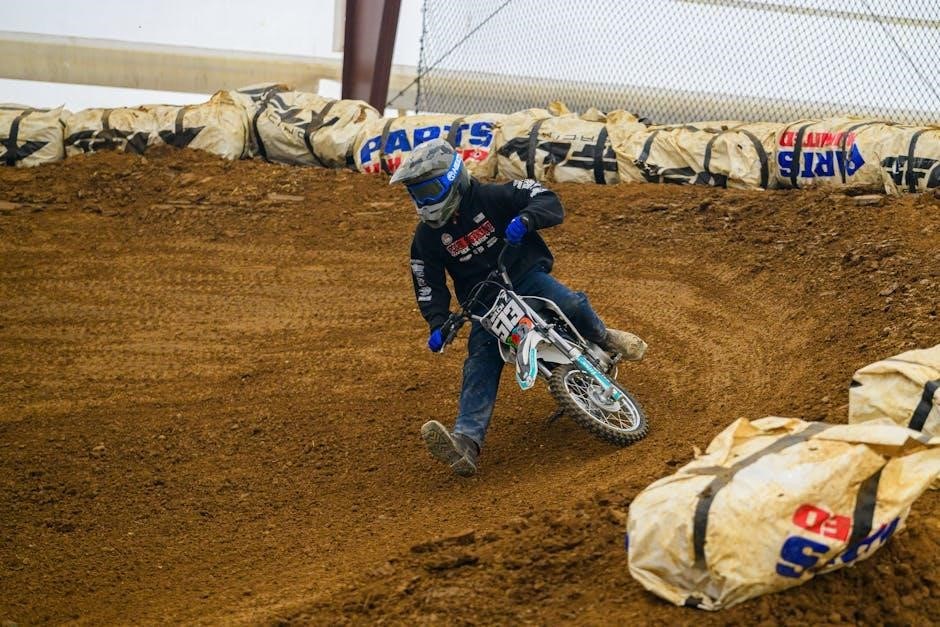
Aggressive tread patterns are essential for enduro riding, featuring large knobs for biting into soft surfaces. Reinforced construction is crucial to resist punctures and tears. Enduro riders often run lower tire pressures to enhance grip, necessitating robust tire choices.
Front Tire Sizes: A Detailed Breakdown
Front tire selection significantly impacts a dirt bike’s steering and handling characteristics. Two primary sizes dominate: 19-inch and 21-inch. The 21-inch is the more common choice, offering increased stability, particularly in rough terrain, and a larger contact patch for improved grip. Widths typically range from 80/100 to 110/90, influencing turning responsiveness.
A narrower tire provides quicker steering, while a wider tire enhances stability. Aspect ratios also play a role, affecting ride height and overall feel. Riders often adjust front tire pressure to fine-tune handling, with lower pressures increasing grip but potentially leading to rim damage.
19-Inch Front Tires: Popular Choices
Nineteen-inch front tires are frequently found on modern motocross bikes, offering a unique blend of handling characteristics. They generally provide quicker steering response compared to their 21-inch counterparts, making them favored by riders prioritizing agility and maneuverability on track. Common widths include 80/100 and 100/90, influencing the tire’s profile and grip.
These tires often feature stiffer sidewalls, enhancing precision during cornering. However, they may transmit more vibrations on rougher terrain. Riders often pair 19-inch fronts with 19-inch rears for balanced handling. Careful consideration of tire pressure is crucial to optimize performance and prevent damage.
21-Inch Front Tires: Standard for Many Bikes
Twenty-one-inch front tires remain a prevalent standard across numerous dirt bike categories, including trail and enduro models. They excel in absorbing impacts from rocks and roots, providing a more comfortable ride and enhanced control on uneven surfaces. Common sizes include 90/90 and 80/100, impacting the tire’s contact patch and steering feel.
The larger diameter offers increased stability, particularly at higher speeds and in rough terrain. While not as quick-steering as 19-inch tires, 21-inch fronts provide superior bump absorption and predictability. Riders often choose these for versatility and confidence-inspiring handling across diverse conditions.
Rear Tire Sizes: A Detailed Breakdown
Rear tire sizing significantly impacts a dirt bike’s traction, acceleration, and overall handling characteristics. Variations in diameter – 18, 19, and 20 inches – cater to different riding disciplines and bike types. Widths range considerably, influencing the tire’s contact patch and grip levels. Understanding these nuances is crucial for optimal performance.
Motocross bikes typically favor 19-inch rear tires, prioritizing quick acceleration and precise handling. Trail and enduro bikes often utilize 18-inch options, offering a balance of traction and comfort. Less common 20-inch sizes find application in specific scenarios, demanding careful consideration of rim compatibility and riding style.
18-Inch Rear Tires: Common for Trail and Enduro
Eighteen-inch rear tires are a prevalent choice for trail and enduro dirt bikes, striking a balance between versatility and performance. They offer enhanced traction on loose surfaces compared to smaller diameters, crucial for navigating varied terrain. This size provides a larger contact patch, improving grip during cornering and braking, essential for technical trails.
The 18-inch diameter also contributes to a more compliant ride, absorbing impacts more effectively than smaller wheels. Common widths range from 110mm to 140mm, influencing handling characteristics. Riders often select wider tires for increased floatation in soft conditions, while narrower options prioritize agility and responsiveness.

19-Inch Rear Tires: Motocross Standard
Nineteen-inch rear tires reign supreme in the world of motocross, engineered for delivering maximum traction and control on tightly packed dirt tracks. This size is favored for its ability to handle aggressive acceleration, hard braking, and sharp cornering – hallmarks of motocross racing. The 19-inch diameter provides a responsive feel, allowing riders to quickly react to changing track conditions.
Typically, motocross bikes utilize tire widths ranging from 110mm to 120mm, optimized for the demands of the sport. These tires feature aggressive tread patterns designed to bite into the track surface, providing exceptional grip. The combination of diameter and tread pattern contributes to predictable handling and enhanced performance.
20-Inch Rear Tires: Less Common Applications
Twenty-inch rear tires represent a niche application within the dirt bike world, appearing less frequently than their 18 and 19-inch counterparts. Their use is often specific to certain vintage bikes or specialized riding scenarios where a larger diameter is deemed beneficial. These tires generally offer a slightly different feel compared to more common sizes, potentially impacting handling characteristics.
While not the standard for modern motocross or trail riding, 20-inch tires can provide increased stability in certain conditions. Finding a wide selection of tread patterns and brands in this size can be more challenging, requiring dedicated searching. Riders opting for 20-inch rear tires should carefully consider rim compatibility and overall bike geometry.
ISO Tire Sizes: The Most Accurate Measurement
ISO tire sizes are widely considered the most precise method for determining tire dimensions, surpassing metric and alpha-numeric systems in accuracy. This standardized numbering system defines the tire’s inner diameter at the bead, ensuring a perfect fit with compatible rims. Unlike other methods prone to slight variations, the ISO number provides a definitive measurement for proper tire and wheel matching.
Understanding the ISO designation is crucial for avoiding fitment issues. It directly correlates to the rim size the tire is designed for, eliminating guesswork. When searching for replacement tires, prioritizing the ISO number guarantees compatibility and safe operation. This system offers a reliable and universal language for tire sizing across different manufacturers and regions.
Metric to Alpha to Inch Tire Size Conversion Charts
Converting between metric, alpha-numeric, and inch-based dirt bike tire sizes can be complex, but charts simplify the process. Metric sizes, like 80/100-21, denote width in millimeters, aspect ratio, and rim diameter in inches. Alpha codes, such as MH or MJ, represent approximate inch equivalents, offering a quick reference. Inch sizes, like 2.75×17, directly state width and diameter.
These conversion charts are essential for cross-referencing when dealing with tires from different regions or manufacturers. They help ensure you select a tire with the correct dimensions for your rims and riding needs. Utilizing these resources prevents incorrect fitment, maintaining optimal handling and safety. Always double-check conversions, as slight variations can occur.
Tire Width and Its Impact on Performance
Dirt bike tire width significantly influences handling characteristics. Narrower tires, like those around 1.60 inches, offer quicker steering response and reduced rolling resistance, ideal for hardpack terrain and tighter trails. Conversely, wider tires, exceeding 3.00 inches, provide increased floatation in soft conditions like sand or mud, enhancing traction and stability.
A wider footprint distributes weight over a larger area, preventing sinking. However, this can make steering feel slower and require more effort. Selecting the appropriate width depends on your typical riding environment and style. Consider the trade-offs between agility and traction when choosing tire width for optimal performance.
Narrower Tires vs. Wider Tires: Handling Characteristics
Narrower tires generally exhibit sharper turning and quicker steering response due to reduced rotational inertia and less sidewall flex. They excel on hard-packed surfaces, offering precise control and a more nimble feel. However, their smaller contact patch can limit traction in loose terrain, potentially leading to slippage.
Wider tires, conversely, provide a larger contact area, maximizing grip on soft surfaces like sand, mud, and loam. This increased traction enhances stability and floatation, but at the cost of steering agility. They require more effort to initiate and complete turns, feeling less responsive than narrower counterparts. The choice hinges on prioritizing agility or traction based on riding conditions.
Aspect Ratio Explained: How it Affects Ride Height
Aspect ratio, the second number in a tire size (e.g., 90 in 80/90-21), represents the tire’s sidewall height as a percentage of its width. A lower aspect ratio signifies a shorter sidewall, resulting in a stiffer tire and reduced suspension travel absorption. This translates to more precise handling but a harsher ride on rough terrain.
Higher aspect ratios mean taller sidewalls, offering increased cushioning and improved comfort. They absorb more impacts, enhancing ride quality, but can lead to vaguer steering and increased sidewall flex. Altering aspect ratio effectively changes the bike’s overall ride height and handling characteristics, impacting geometry and stability.
Understanding Tire Bead Diameter and Rim Compatibility
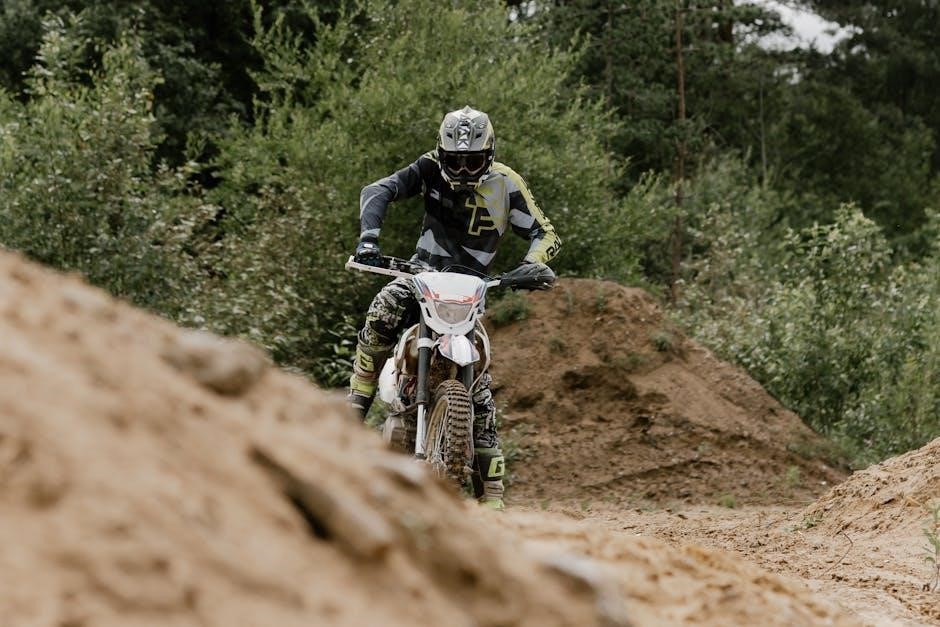
Tire bead diameter, the final number in a tire size (e.g., 21 in 80/90-21), indicates the diameter of the tire’s inner edge that seats onto the wheel rim. This measurement must match the rim’s diameter for a secure fit and safe operation. Incorrect matching can lead to tire dismounting during riding, posing a significant safety hazard.
Rim compatibility is crucial; a 21-inch tire requires a 21-inch rim, and so on. Different dirt bike models utilize varying rim sizes, so verifying the correct bead diameter is paramount when selecting new tires. Ignoring this specification can compromise handling, stability, and overall bike performance.
Dirt Bike Tire Conversion Chart: Common Sizes
Converting between metric, alpha, and inch tire sizes can be confusing, but understanding common equivalencies simplifies the process. For example, a 70/100×17 tire roughly equates to a 2.75×17 inch size. Similarly, an 80/100×21 translates to approximately a 3.00×21 inch tire. A 90/100×14 is often comparable to a 4.10×14 inch tire, while 90/100×16 aligns with a 4.10×16 inch size.
These conversions are approximate, and slight variations may exist between manufacturers. Always prioritize the ISO size for the most accurate fit. Utilizing a comprehensive chart ensures proper tire selection, maximizing performance and safety on the track or trail.
Choosing the Right Tire for Your Riding Style
Selecting the ideal dirt bike tire hinges on your riding style and terrain. Aggressive tread patterns, featuring large knobs, excel in mud and sand, providing superior traction in loose conditions. Intermediate tread patterns strike a balance, offering versatility across various surfaces – hardpack, loam, and moderate mud. These tires provide a good compromise between grip and longevity.
For maximum grip on challenging terrain, knobby tires are essential. Consider the knob height and spacing; taller, widely spaced knobs dig deeper into soft surfaces. Matching your tire choice to your riding environment dramatically improves control and performance.
Aggressive Tread Patterns for Mud and Sand
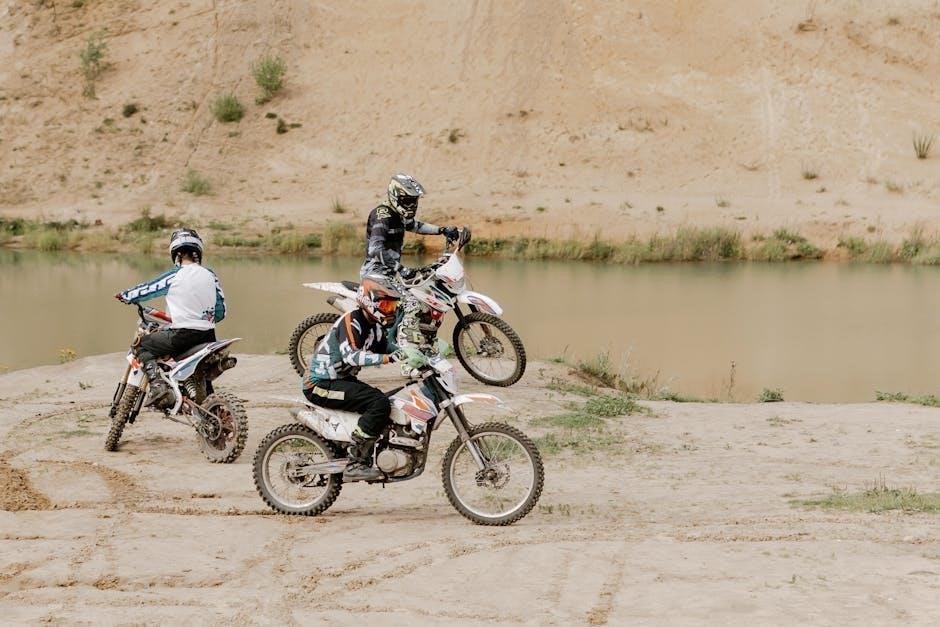
Aggressive dirt bike tire tread patterns are specifically engineered for optimal performance in challenging, loose conditions like mud and sand. These tires boast large, widely spaced knobs designed to dig deep and maintain traction where others struggle. The open design allows for efficient self-cleaning, preventing mud from building up and reducing grip.
Look for tires with paddle-shaped knobs for enhanced flotation in sand, and larger, more pronounced knobs for clawing through deep mud. These tires often sacrifice some stability on hardpack surfaces, but the trade-off is significant gains in traction when the terrain gets demanding.
Intermediate Tread Patterns for Versatility
Intermediate dirt bike tire tread patterns strike a balance between aggressive mud/sand tires and more hardpack-focused designs, offering commendable versatility across a wider range of conditions. These tires feature moderately sized knobs, often with a mix of spacing and shapes, providing decent grip on both loose and firmer surfaces.
They excel in situations where terrain changes frequently, such as trail riding or enduro competitions. While not the absolute best in any single condition, intermediate tires deliver predictable handling and consistent performance, making them a popular choice for riders seeking a jack-of-all-trades option.
Knobby Tires for Maximum Grip
Knobby dirt bike tires are engineered for uncompromising grip in challenging, soft-terrain conditions like mud, sand, and loose dirt. Characterized by large, widely spaced knobs, these tires dig aggressively into the surface, providing exceptional traction and control where other tires might struggle. The open tread pattern efficiently sheds mud and debris, maintaining grip even in the most demanding environments.
However, knobby tires typically offer reduced performance on hardpack surfaces, as the large knobs can feel squirmy and unstable. They are the preferred choice for dedicated motocross racing in muddy conditions or for riders who frequently encounter extremely soft terrain.

Tire Pressure Recommendations for Different Terrains
Optimal tire pressure is critical for maximizing dirt bike performance and rider comfort, varying significantly based on terrain and riding style. For soft terrain like sand, lower pressures (around 12-15 PSI) increase the tire’s contact patch, enhancing floatation and traction. Conversely, hardpack terrain demands higher pressures (18-22 PSI) to prevent pinch flats and maintain responsiveness.
Muddy conditions benefit from slightly lower pressures (14-18 PSI) to allow the knobs to dig in, while rocky terrain requires higher pressures (20-25 PSI) for impact protection. Always consult your bike’s manual and tire manufacturer’s recommendations as a starting point, and adjust based on personal preference and riding conditions.
Tools for Measuring Tire Size and Wear
Accurately assessing tire size and wear is vital for safety and performance. A simple ruler or tape measure can verify tire width, though ISO sizing offers the most precise measurement at the bead. Depth gauges, readily available at auto parts stores, are essential for checking tread depth – a minimum of 2mm is generally recommended before replacement.
Visual inspection for cuts, bulges, or uneven wear patterns is crucial. Tire pressure gauges are indispensable for maintaining correct inflation. Digital calipers provide highly accurate measurements for both width and depth. Regularly monitoring these aspects ensures optimal grip, handling, and extends tire lifespan, preventing unexpected failures on the trail.
Where to Find Reliable Tire Size Information
Locating accurate tire size data is paramount for correct fitment. Your dirt bike’s owner’s manual is the primary source, detailing original equipment (OE) sizes. Manufacturer websites – like Dunlop, Michelin, and Pirelli – offer comprehensive specifications and compatibility charts for their products.
Reputable online retailers specializing in dirt bike parts often include detailed tire sizing information. Forums dedicated to specific bike models can provide valuable insights from experienced riders. Cross-reference information from multiple sources to confirm accuracy, especially when considering aftermarket tire options. Always prioritize information from trusted and established sources to avoid incorrect fitment and potential safety hazards.
Resources for Dirt Bike Tire Selection
Numerous resources assist in choosing the ideal dirt bike tires. Websites like RevZilla and Rocky Mountain ATV/MC offer extensive catalogs with detailed product descriptions and customer reviews. Tire manufacturers’ websites provide comparison tools and guidance based on riding style and terrain.
Dedicated online forums, such as DirtBikeTalk and ThumperTalk, host discussions where riders share experiences and recommendations. YouTube channels featuring tire reviews and installation guides can be incredibly helpful. Consulting with local motorcycle shops, particularly those specializing in off-road bikes, provides personalized advice from knowledgeable professionals. Utilize these resources to make an informed decision.
Confused about dirt bike tire sizing? Our easy guide breaks down everything you need to know to choose the right tires for peak performance & fun! ⚙